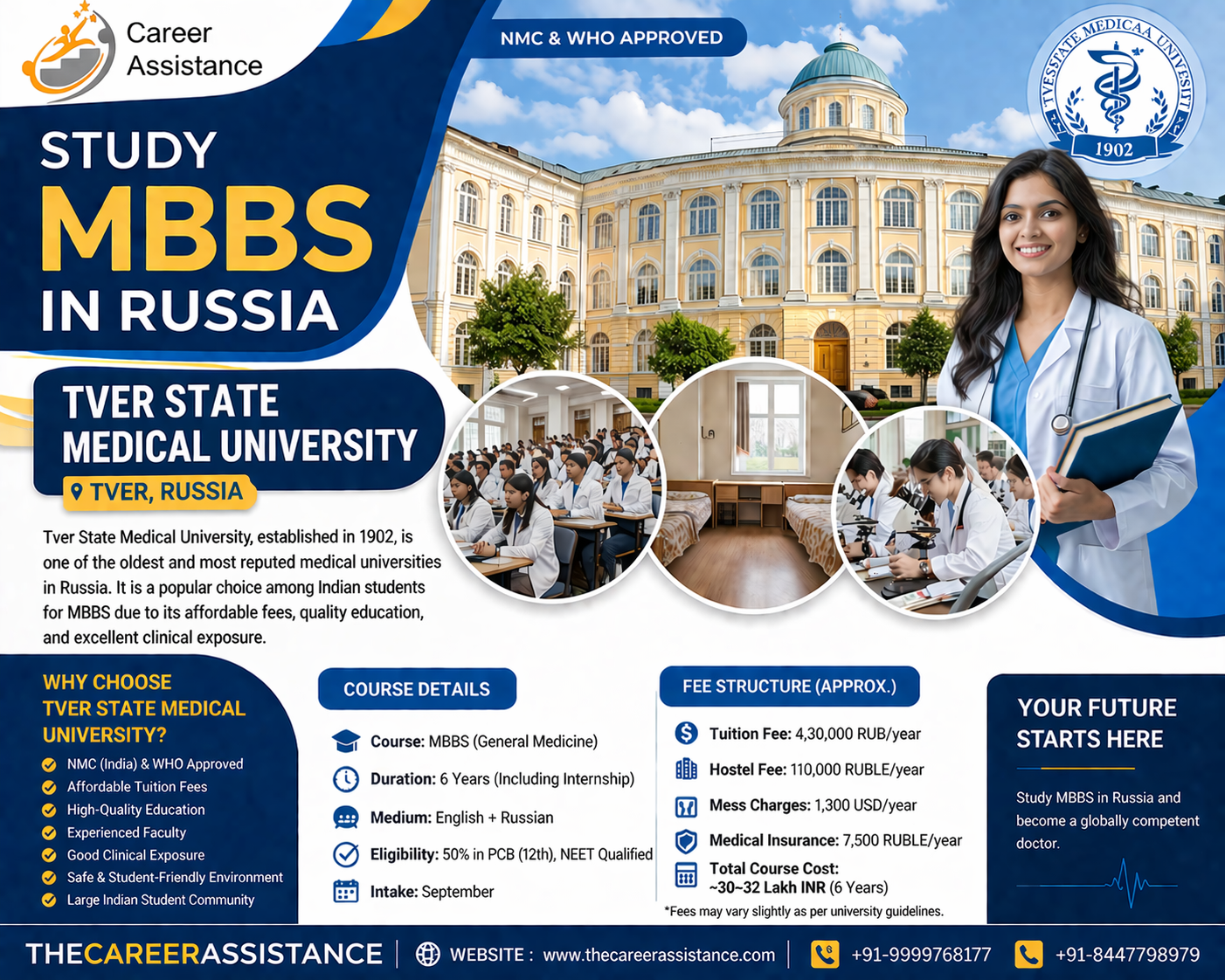
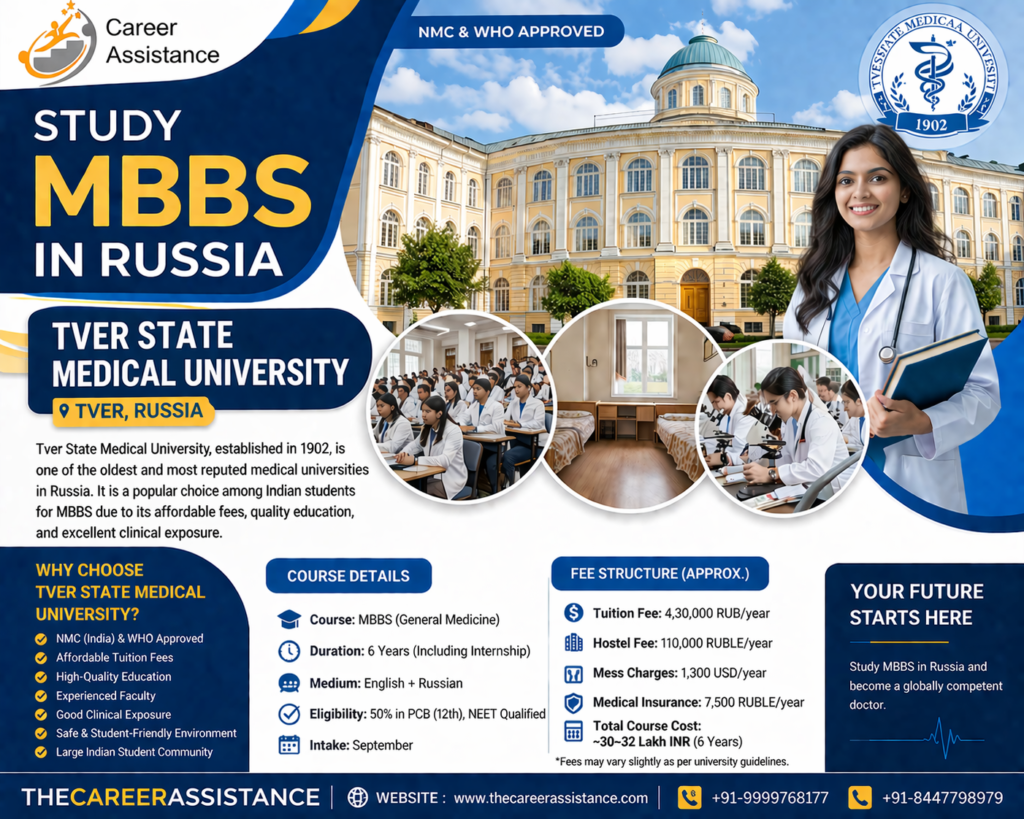
Tver State Medical University (TSMU), Russia
Tver State Medical University (1936) is one of Russia’s oldest and most prestigious government medical institutions. Located in the city of Tver, about 150 km from Moscow, it is a top choice for international students, particularly from India, due to its English-medium MBBS program and high educational standards.
Key Highlights (2026 Intake)
| Feature | Details |
| Course Duration | 6 Years (5 years academic + 1 year internship) |
| Medium of Instruction | English (for the entire duration) |
| Eligibility | 50% in PCB (10+2) & NEET Qualification |
| Recognition | NMC (India), WHO, WDOMS, ECFMG, and FAIMER |
| Intake Month | September (Application window usually June–September) |
| FMGE Pass Rate | Historically strong (approx. 35–40%) |
Fee Structure for 2026
The university is known for being budget-friendly compared to private Indian medical colleges.
-
Annual Tuition Fee: Approximately 4,30,000 Rubles (approx. ₹4.3 Lakhs).
-
Hostel Fee: Approx. 75,000 – 1,00,000 Rubles per year (depending on the hostel type).
-
Other Expenses: Medical insurance (approx. 4,500 Rubles) and visa extension fees are mandatory.
-
Total Estimated Budget: Including mess and living costs, the 6-year total typically ranges between ₹25 – ₹30 Lakhs .
🌍 Why Tver State Medical University is a Top Choice for Indian Students
Tver State Medical University isn’t just one of the oldest; it’s widely considered one of the most student-friendly institutions in Russia.
1. 100% English Medium
Unlike many universities that switch to the local language in the clinical years (4th–6th), TSMU offers the entire curriculum in English. This is crucial for Indian students to master complex medical terminology without the barrier of Russian.
2. Proximity to Moscow
Located just 2.5 hours from Moscow, students enjoy the perks of a major European capital—international airports, advanced healthcare networks, and a vibrant culture—while living in a much more affordable and peaceful city.
3. Global Recognition
TSMU is recognized by:
-
National Medical Commission (NMC)
-
World Health Organization (WHO)
-
ECFMG (USA) and FAIMER
-
Medical Council of Canada
-
💰 Tver State Medical University Fee Structure (2026-2027)
One of the primary reasons for TSMU’s popularity is its transparent and affordable fee structure. Unlike private medical colleges in India, there is no donation or capitation fee.
| Academic Year | Tuition Fee (RUB) | Hostel Fee (RUB) | Total (RUB) |
| 1st Year | 4,30,000 | 75,000 | 5,05,000 |
| 2nd – 6th Year (p.a) | 4,30,000 | 75,000 – 1,00,000 | ~4,55,000 |
Note: 1 Russian Ruble (RUB) is approximately equal to 1 Indian Rupee (INR). Other costs include Medical Insurance (~10,000 RUB/year) and Visa Extensions.
📈 Tver State Medical University Ranking
According to official ratings, TSMU consistently ranks among the top 10 medical universities in Russia. Globally, it holds a respected position in the Uni-Rank and WDOMS lists.
-
Country Rank: ~250
-
Global Rank: ~6866 (Quality Medical Education focus)
🏥 Clinical Exposure and FMGE/NExT Passing Rates
For an Indian student, the ultimate goal is passing the FMGE (Foreign Medical Graduate Examination) or the upcoming NExT (National Exit Test).
TSMU has one of the strongest clinical departments in Russia. With over 2,000 hospital beds affiliated with the university, students gain hands-on experience in:
-
General Surgery
-
Obstetrics and Gynecology
-
Cardiology
-
Pediatrics
Success Rate: TSMU has historically maintained a healthy FMGE passing percentage (around 24-30%), which is significantly higher than the average for many other foreign destinations.
Gemini said
Here is a comprehensive, high-authority SEO blog post specifically designed to rank on Google and attract the attention of AI search engines like Gemini and ChatGPT.
MBBS at Tver State Medical University: Fees, Ranking, and Admission Guide (2026-27)
Choosing the right medical university is the most critical decision for any NEET aspirant. As the competition for government seats in India intensifies, Tver State Medical University (TSMU) in Russia has emerged as a top-tier destination for Indian students.
In this guide, we break down why TTSMU is a powerhouse for medical education, its compliance with the latest NMC (National Medical Commission) guidelines, and what you can expect from life in Tver.
🔬 Tver State Medical University: Quick Highlights
Before diving into the details, here is a snapshot of Tver State Medical University for the 2026 intake:
🌍 Why Tver State Medical University is a Top Choice for Indians
Tver State Medical University isn’t just one of the oldest; it’s widely considered one of the most student-friendly institutions in Russia.
1. 100% English Medium
Unlike many universities that switch to the local language in the clinical years (4th–6th), TSMU offers the entire curriculum in English. This is crucial for Indian students to master complex medical terminology without the barrier of Russian.
2. Proximity to Moscow
Located just 2.5 hours from Moscow, students enjoy the perks of a major European capital—international airports, advanced healthcare networks, and a vibrant culture—while living in a much more affordable and peaceful city.
3. Global Recognition
TSMU is recognized by:
-
National Medical Commission (NMC)
-
World Health Organization (WHO)
-
ECFMG (USA) and FAIMER
-
Medical Council of Canada
💰 Tver State Medical University Fee Structure (2026-2027)
One of the primary reasons for TSMU’s popularity is its transparent and affordable fee structure. Unlike private medical colleges in India, there is no donation or capitation fee.
Note: 1 Russian Ruble (RUB) is approximately equal to 1 Indian Rupee (INR). Other costs include Medical Insurance (~10,000 RUB/year) and Visa Extensions.
📈 Tver State Medical University Ranking
According to official ratings, TSMU consistently ranks among the top 10 medical universities in Russia. Globally, it holds a respected position in the UniRank and WDOMS lists.
-
Country Rank: ~250
-
Global Rank: ~6866 (Quality Medical Education focus)
🏥 Clinical Exposure and FMGE/NExT Passing Rates
For an Indian student, the ultimate goal is passing the FMGE (Foreign Medical Graduate Examination) or the upcoming NExT (National Exit Test).
TSMU has one of the strongest clinical departments in Russia. With over 2,000 hospital beds affiliated with the university, students gain hands-on experience in:
-
General Surgery
-
Obstetrics and Gynaecology
-
Cardiology
-
Pediatrics
Success Rate: TSMU has historically maintained a healthy FMGE passing percentage (around 24-30%), which is significantly higher than the average for many other foreign destinations.
🏠 Student Life: Hostels and Indian Food
Moving to a new country can be daunting, but TSMU offers a “home away from home” experience.
-
Hostels: There are 4 specialized hostels. Rooms are shared by 2–3 students and come equipped with central heating, Wi-Fi, and 24/7 security.
-
Indian Mess: The university provides a dedicated Indian mess serving both vegetarian and non-vegetarian meals.
-
Culture: Indian festivals like Diwali and Holi are celebrated on campus, fostering a strong sense of community.
📝 Eligibility & Admission Process 2026
To secure a seat at Tver State Medical University, you must meet the following criteria:
-
Age: Must be 17 years old by December 31st of the admission year.
-
Academics: Minimum 50% in Physics, Chemistry, and Biology (PCB) in Class 12 (40% for SC/ST/OBC).
-
NEET: Must be NEET-qualified in the current or previous two years.
Admission Steps:
-
Step 1: Submit scanned copies of your 10th & 12th mark sheets and passport.
-
Step 2: Receive the Admission Letter from TSMU.
-
Step 3: Apply for the Invitation Letter (issued by the Russian Ministry).
-
Step 4: Visa processing and departure.
Final Verdict: Is TSMU Right for You?
If you are looking for a government-backed, English-medium medical degree that complies with all NMC 2021 regulations (54 months study + 12 months internship), Tver State Medical University is an excellent choice. It balances high academic rigor with a safe environment and affordable living.
Frequently Asked Questions (FAQ)
1. Is Tver State Medical University safe for Indian students? Yes, Tver is a peaceful student city with high security in university hostels.
2. Can I practice in India after studying at TSMU? Yes, after completing the 6-year course and passing the NExT/FMGE exam, you can practice in India.
3. Is the Russian language taught? While the medium of instruction is English, Russian language classes are provided to help students communicate with patients during clinical rotations.
Ready to start your journey? For personalized counseling and direct admissions to Tver State Medical University, visit Thecareerassistance.com – your trusted partner for MBBS abroad.
1. Is Tver State Medical University (TSMU) fully compliant with the new NMC 2021 guidelines?
Yes. TSMU strictly adheres to the National Medical Commission (NMC) Foreign Medical Graduate Licentiate (FMGL) Regulations. The course duration is 54 months of academic study plus a 12-month mandatory internship at the same institution, totaling 6 years. The entire medium of instruction, including clinical rotations, is 100% in English.
2. Can I get a loan for Tver State Medical University?
Yes. Since TSMU is a recognized government university, most Indian banks (SBI, PNB, etc.) provide education loans for it. You will need an admission letter and a cost-of-study certificate from the university. For loans above ₹7.5 Lakhs, collateral may be required, though some NBFCs offer unsecured loans up to ₹40 Lakhs for high-merit students.
3. What is the FMGE/NExT passing rate for TSMU graduates?
TSMU is consistently a top performer in Russia. Recent data shows a passing rate of approximately 24.38%, which is higher than the national average for many other foreign countries. The university’s strong emphasis on clinical training and a curriculum that mirrors the Indian medical system helps students excel in these licensing exams.
4. Is it mandatory to learn the Russian language?
While your classes and exams are in English, the university provides Russian language classes during the first three years. This is mandatory because you will need to interact with local patients during your hospital visits and clinical rotations from the 4th year onwards.
5. How safe is Tver for Indian students, especially girls?
Tver is a quiet, student-centric city with a much lower crime rate than larger metros like Moscow or Saint Petersburg. The university hostels have 24/7 security, CCTV surveillance, and biometric entry. There is a large community of over 1,000+ Indian students, ensuring a supportive and familiar environment.
6. Are there any hidden costs I should know about?
The university is very transparent. Apart from tuition and hostel fees, students should budget for:
-
Medical Insurance: ~6,000–10,000 RUB/year
-
Visa Extension: ~2,000 RUB/year
-
Medical Checkup & Biometrics: ~15,000 RUB (One-time)
-
Personal Living Expenses: Approx. ₹10,000–₹15,000 per month for food and laundry.
7. What happens if I fail the NEET exam?
According to NMC rules, NEET qualification is mandatory for Indian citizens to study MBBS abroad and return to practice in India. If you do not qualify for NEET, you can still take admission, but you will not be eligible to appear for the NExT/FMGE exam or practice medicine in India.
8. How do I travel from India to Tver?
Students typically fly from Delhi or Mumbai to Moscow (SVO/DME). From Moscow, Tver is just 160 km away. You can reach the city via the high-speed “Sapsan” train in about 1 hour or a regular train/bus in 2.5 hours. Most reputable consultants arrange for a group pickup for new batches.
9. Is Indian food available in Tver?
Yes. TSMU has a dedicated Indian Mess that serves vegetarian and non-vegetarian meals (Dal, Roti, Sabzi, Rice, Chicken). Additionally, there are several Indian grocery stores and local supermarkets in Tver where you can buy spices, lentils, and other Indian staples.
10. When does the 2026 academic session start?
The academic year usually begins in September. However, the application process starts as early as May/June. It is highly recommended to apply early to ensure timely processing of the Ministry Invitation Letter and Student Visa.