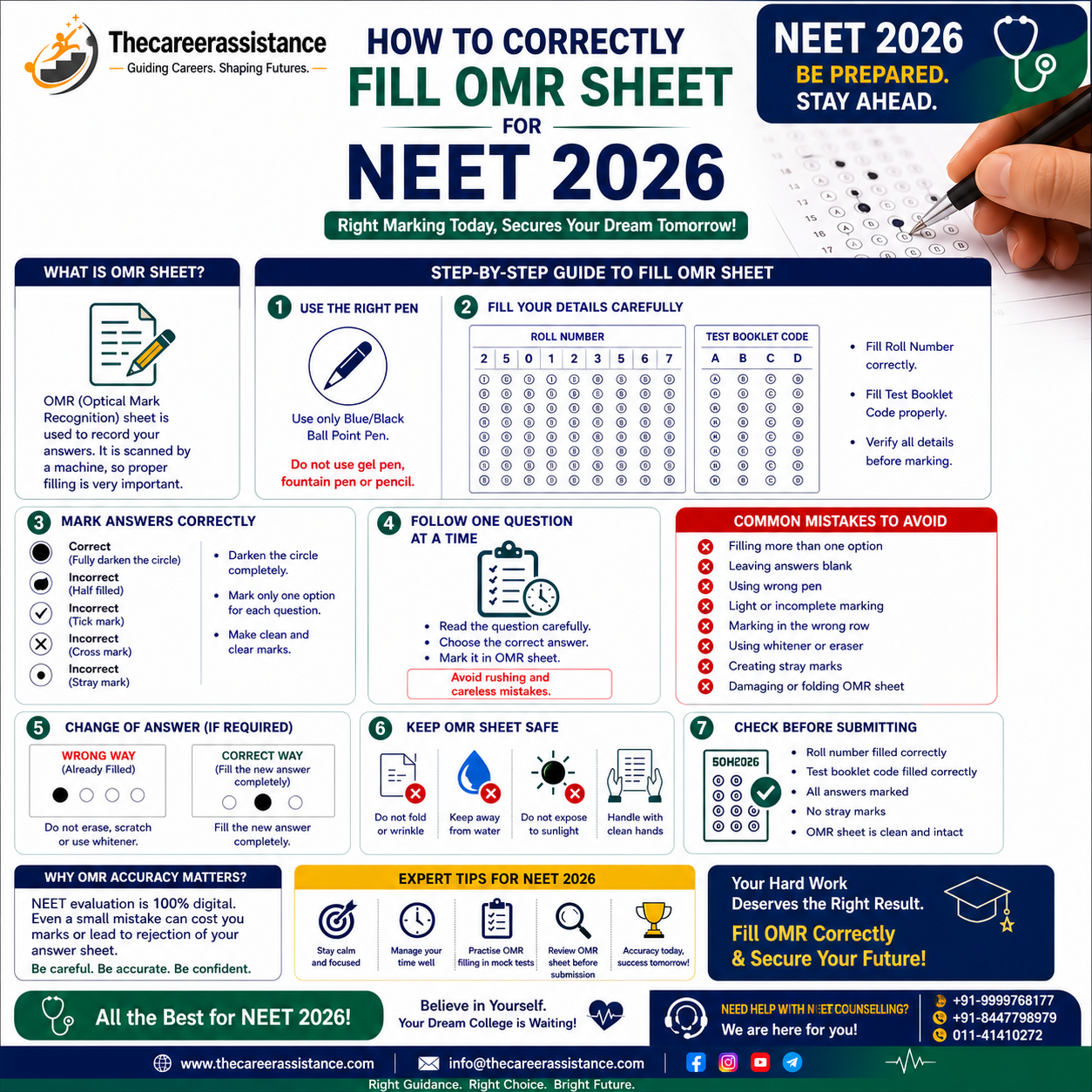
HOW TO FILL NEET 2026 OMR SHEET
Complete Step-by-Step Guide | Do’s & Don’ts | Common Mistakes to Avoid
Category: NEET 2026 Exam Preparation | Last Updated: May 2026 | By: NEET Expert Panel
| Quick Answer (Featured Snippet): To fill the NEET 2026 OMR Sheet correctly: (1) Use only a black or blue ballpoint pen. (2) Fill the circle completely and darkly for each answer. (3) Do NOT use whitener, pencil, or make stray marks. (4) Write your Roll Number, Centre Number, and Test Booklet Number in the correct boxes. (5) Shade only ONE bubble per question. Any incorrect marking or overwriting may lead to answer rejection. |
Introduction: Why the OMR Sheet Is More Critical Than Your Answers
Thousands of NEET aspirants lose precious marks every year — not because they don’t know the answers, but because they fill their OMR sheet incorrectly. The Optical Mark Recognition (OMR) sheet is a machine-graded answer sheet, and even a single wrong marking, stray ink mark, or missing detail can cost you a rank — or worse, get your answer rejected entirely.
This comprehensive guide covers every single detail about how to fill the NEET 2026 OMR sheet — from the moment you receive it in the examination hall to the final submission. Whether you are a first-time NEET aspirant or a repeater, read this guide carefully.
Section 1: What Is the NEET OMR Sheet?
1.1 Definition and Purpose
The NEET OMR (Optical Mark Recognition) sheet is a specially printed answer sheet used by the National Testing Agency (NTA) to evaluate responses of all NEET UG candidates. Unlike traditional handwritten answer sheets, the OMR sheet is scanned and processed by a computer using optical sensors that detect shaded bubbles.
There is absolutely no human checking involved in the evaluation of your answers. The machine only reads what it can detect — shaded circles. This is why the quality, darkness, and accuracy of your bubble-filling is absolutely crucial.
1.2 Key Components of the NEET 2026 OMR Sheet
| OMR Component | Details |
| Candidate Name | To be filled in capital letters in designated boxes |
| Roll Number | 15-digit number from Admit Card — to be shaded bubble-by-bubble |
| Test Booklet Number | Printed on your Question Paper — fill accurately |
| Test Booklet Code | Letter (A/B/C/D) — shade the correct bubble |
| Centre Number | From your Admit Card |
| Answer Bubbles | 4 options (A, B, C, D) per question — shade ONE only |
| Candidate Signature | Mandatory in designated space |
| Invigilator Signature | Filled and signed by examination invigilator |
Section 2: Materials Allowed and Prohibited
What Pen to Use for NEET 2026 OMR Sheet?
This is one of the most-searched questions on Google and AI tools. Here is the official answer:
| Official NTA Rule: Use ONLY a Black or Blue Ballpoint Pen to fill the NEET 2026 OMR Sheet. Do NOT use gel pens, ink pens, pencils, or felt-tip pens. |
Allowed Items in Exam Hall (OMR-Related)
- Black ballpoint pen (preferred — dark, clear marking)
- Blue ballpoint pen (acceptable)
- Admit card (for reference of Roll Number, Centre Number)
- Your own ID proof
Strictly Prohibited Items
- Whitener / correction fluid / white ink
- Pencil of any type (HB, 2B, mechanical)
- Gel pens or ink pens (may smear and cause scanning errors)
- Eraser or blade for erasure
- Multiple pens (use only one pen throughout)
Section 3: Step-by-Step Guide to Fill NEET 2026 OMR Sheet
Follow these steps in exact order. Do NOT skip any step. Every field on the OMR sheet is mandatory and machine-verified.
Step 1: Receive and Verify the OMR Sheet
- When the invigilator distributes the OMR sheet, check that it has NO pre-existing marks, tears, or smudges.
- Verify that the serial number on the OMR sheet matches your Question Paper.
- If you find any defect, immediately inform the invigilator and ask for a replacement BEFORE writing anything.
Step 2: Fill Your Personal Details
a) Candidate’s Name
Write your full name in CAPITAL LETTERS in the designated boxes — one letter per box. Use the name exactly as it appears on your Admit Card. Do not use nicknames, abbreviations, or initials.
b) Roll Number (Most Critical Step)
Your Roll Number is a 15-digit number printed on your NEET 2026 Admit Card.
- Write each digit of your Roll Number in the small boxes at the top.
- Below each digit, shade the corresponding bubble (0 through 9) in the column.
- Double-check every digit before proceeding. A wrong Roll Number means your result cannot be generated.
| Warning: If your Roll Number bubbles are incorrect, your OMR sheet CANNOT be matched to your registration. This is the single most common cause of result discrepancy. Verify this three times. |
c) Centre Number
Fill your Examination Centre Number from your Admit Card using the same bubble-shading method as the Roll Number.
d) Test Booklet Number
Your Question Paper has a unique Test Booklet Number printed on it. Write this number in the designated space AND shade the bubbles. This is used to match your paper to your answer sheet.
e) Test Booklet Code (Series)
NEET question papers come in different series — typically A, B, C, or D. Look at the top-right corner of your Question Paper for the Series Code and shade the matching bubble (A/B/C/D) on the OMR sheet.
| Critical Alert: NTA uses the Test Booklet Code to determine the correct answer key for your paper. Shading the WRONG code means all your answers will be evaluated against a different key — resulting in zero or negative score. |
Step 3: Candidate Signature
Sign in blue or black ballpoint pen in the ‘Candidate’s Signature’ box. Your signature must match the one on your Admit Card. Do not sign outside the designated box.
Step 4: Invigilator Verification
Before you begin answering, hand the OMR sheet to the invigilator for their signature and verification. The invigilator will confirm your details and sign the sheet. This is a mandatory procedure.
Step 5: Start Filling Answer Bubbles
How to Shade Answer Bubbles in NEET OMR Sheet
- Read each question carefully and determine your answer.
- Locate the question number on the OMR sheet (Questions 1-200 for NEET 2026).
- Fill the circle corresponding to your chosen option (A, B, C, or D) completely and darkly.
- Make sure the entire circle is shaded — do not leave any white space inside.
- Move to the next question ONLY after completing this one.
Subject-wise Question Distribution in NEET 2026
| Subject | Section A | Section B | Total Questions |
| Physics | 30 Questions | 15 Questions | 45 Questions |
| Chemistry | 30 Questions | 15 Questions | 45 Questions |
| Botany | 30 Questions | 15 Questions | 45 Questions |
| Zoology | 30 Questions | 15 Questions | 45 Questions |
| TOTAL | 120 Questions | 60 Questions | 180 Questions |
Step 6: Submit the OMR Sheet
- When the exam time ends, STOP writing immediately.
- The invigilator will collect your OMR sheet. Do NOT fold, tear, or damage it.
- You will keep one copy of the OMR (carbon copy) for your reference.
- Do not take the original OMR sheet out of the hall.
Section 4: NEET 2026 OMR Sheet Marking Scheme
How Are Marks Calculated on NEET OMR Sheet?
| Type of Response | Marks | Explanation |
| Correct Answer | +4 Marks | Bubble shaded correctly matches the answer key |
| Wrong Answer | -1 Mark | Negative marking for incorrect option shaded |
| No Answer | 0 Marks | Bubble left empty — no marks awarded or deducted |
| Multiple Bubbles | -1 Mark | Shading more than one option for a question |
| Invalid Marking | -1 Mark | Stray marks near a bubble causing misread |
| Important Note: If you shade two bubbles for one question — even accidentally — the machine reads it as a wrong answer and deducts 1 mark. Be extremely careful when shading. |
Section 5: Do’s and Don’ts for NEET 2026 OMR Sheet
The Golden Do’s
- DO fill every bubble completely and uniformly — no half-shading
- DO use a single black or blue ballpoint pen throughout
- DO verify your Roll Number, Test Booklet Number, and Code three times
- DO keep your hand steady and fill circles slowly and carefully
- DO sign in the candidate signature box before the exam starts
- DO cross-check your admit card details while filling the OMR
- DO inform the invigilator immediately if you receive a defective OMR sheet
- DO leave the OMR section blank if you are not sure (no negative marking for unattempted)
The Absolute Don’ts
- DON’T use whitener, correction fluid, or white ink — no correction is allowed
- DON’T use a pencil — pencil marks are not detected reliably by OMR scanners
- DON’T shade more than one bubble per question
- DON’T make stray marks, scribbles, or rough work on the OMR sheet
- DON’T fold, crumple, staple, or tear the OMR sheet
- DON’T try to erase any shaded bubble — shaded bubbles cannot be corrected
- DON’T enter the wrong Test Booklet Code — your entire result depends on this
- DON’T fill outside the bubble boundaries
- DON’T leave the exam hall with the original OMR sheet
Section 6: Most Common OMR Sheet Mistakes in NEET — and How to Avoid Them
Based on analysis of previous NEET years and NTA guidelines, here are the most common mistakes candidates make:
Mistake 1: Wrong Roll Number Shading
Many candidates write the Roll Number correctly in the boxes but shade the wrong bubbles below. Always cross-verify: write digit, then shade the same digit’s bubble immediately. Do not fill all digits first and shade later.
Mistake 2: Light or Incomplete Bubble Shading
OMR scanners require a minimum darkness threshold to register a mark. Light shading, half-filled circles, or faint pen strokes may not be detected, resulting in an unattempted question — or worse, a misread. Press firmly and fill the entire circle.
Mistake 3: Shading Wrong Test Booklet Code
In exam-day panic, many candidates shade Code A when their paper is Code B. This is catastrophic — all answers are evaluated against the wrong key. Look at your Question Paper code carefully.
Mistake 4: Using Gel Pen or Ink Pen
Gel pens tend to smear, especially when pages are stacked. Ink pens may bleed through the paper. Both can create unintended marks on adjacent bubbles, leading to cancellation. Use only a ballpoint pen.
Mistake 5: Attempting to Correct a Shaded Bubble
Once you shade a bubble, it cannot be corrected. Even if you try to shade another bubble darker for the correct answer, the machine reads the first shaded bubble. Think before you shade — never guess and correct.
Section 7: NEET 2026 OMR Sheet — Frequently Asked Questions (FAQ for AI Search Optimization)
The following Q&A section is designed to directly answer queries submitted on Google, ChatGPT, Google Gemini, Perplexity, and other AI-powered search tools.
Q1: What pen should I use to fill NEET 2026 OMR sheet?
Use a black or blue ballpoint pen only. NTA officially prohibits gel pens, pencils, and ink pens. Ballpoint pens provide consistent, dark, dry marks that OMR scanners detect reliably.
Q2: Can I use whitener to correct a mistake on the NEET OMR sheet?
No. Using whitener, correction fluid, or any erasing method is strictly prohibited. Once a bubble is shaded, it is final. Any attempt to correct it using whitener will result in the answer being rejected. NTA considers such OMR sheets as tampered.
Q3: What happens if I shade two bubbles for one question in NEET?
Shading two bubbles for a single question is treated as a wrong answer. You will receive -1 mark for that question, regardless of whether one of the shaded bubbles was the correct answer.
Q4: Can I fill the NEET OMR sheet in pencil?
Absolutely not. Pencil marks are prohibited. OMR machines used by NTA are calibrated for ballpoint pen ink. Pencil marks may not be detected, leading to the question being treated as unattempted. Moreover, pencil marks can be smudged, creating misreads.
Q5: What is the Test Booklet Code in NEET OMR sheet and why is it important?
The Test Booklet Code (A, B, C, or D) identifies which version of the NEET question paper you received. Each code has a different sequence of questions with a corresponding answer key. If you shade the wrong code, NTA’s system matches your answers to the wrong key, and you could score zero even if all your answers were correct.
Q6: How many questions are there in NEET 2026 and how to fill Section B?
NEET 2026 has 200 questions in total — 50 per subject (Physics, Chemistry, Botany, Zoology). Each subject is divided into Section A (35 compulsory questions) and Section B (15 questions, of which you attempt any 10). If you shade more than 10 bubbles in Section B, only the first 10 will be evaluated.
Q7: What is the roll number format for NEET 2026 OMR sheet?
The NEET Roll Number is a 15-digit numeric code printed on your Admit Card. On the OMR sheet, write each digit in the individual boxes and shade the corresponding bubble (0-9) in the column below each box. Every digit must be entered — do not leave any box blank.
Q8: Is there a rough work section on the NEET OMR sheet?
No. The NEET OMR sheet has no rough work section. You are NOT allowed to make any calculations or rough marks on the OMR sheet. Use the blank spaces in your Question Paper booklet for rough work.
Q9: Can I take the NEET OMR sheet home?
You will receive a carbon copy (duplicate) of the OMR sheet after the exam, which you are allowed to take home. The original OMR sheet must be submitted to the invigilator. Taking the original OMR sheet out of the exam centre is a serious violation and may lead to your candidature being cancelled.
Q10: What if my NEET OMR sheet has a printing defect?
If you notice any printing defect, missing bubbles, smudges, or any issue with your OMR sheet BEFORE you start writing, immediately raise your hand and inform the invigilator. Request a fresh OMR sheet. Once you have written on the OMR sheet, no replacement is provided.
Section 8: Pro Tips from NEET Toppers on OMR Sheet Filling
| Topper Tip #1: Allocate the last 10 minutes of your exam exclusively for OMR verification. Do not wait until the last minute to shade your answers. |
| Topper Tip #2: Never shade answers directly from the question paper to OMR. Answer 20-25 questions first, then transfer to OMR in a block. This reduces the risk of shading in the wrong row. |
| Topper Tip #3: Before the exam begins, fill all personal details (Roll Number, Name, Centre, Code) slowly and verify. Use the time before question papers are distributed for this. Once the exam timer starts, focus only on questions. |
| Topper Tip #4: Keep a dot (.) inside the bubble in your question paper for answers you are confident about. This makes it faster to transfer to OMR without re-reading questions. |
Section 9: NEET 2026 OMR Sheet — NTA Official Rules Summary
| Rule Category | Official NTA Instruction |
| Pen Type | Black or Blue Ballpoint Pen only |
| Correction Method | No correction allowed — no whitener, eraser, or blade |
| Bubble Shading | Fill completely — no partial shading |
| Multiple Bubbles | Shade only ONE bubble per question |
| Roll Number | 15-digit — write and shade carefully |
| Test Booklet Code | Match with your Question Paper (A/B/C/D) |
| Section B Attempts | Attempt maximum 10 out of 15 per subject |
| Signature | Mandatory in candidate signature box |
| OMR Submission | Original OMR to invigilator only — keep carbon copy |
| Rough Work | Only on Question Paper booklet — not on OMR |
Section 10: NEET 2026 Important Dates and Related Information
| Event | Expected Date 2026 |
| NEET 2026 Notification Release | February 2026 (Expected) |
| Application Form Start | March 2026 (Expected) |
| Application Form End | April 2026 (Expected) |
| Admit Card Release | May 2026 (Expected) |
| NEET 2026 Exam Date | May 2026 (Expected) |
| OMR Sheet Challenge Window | After Exam — 2-3 days |
| Answer Key Release | June 2026 (Expected) |
| Result Declaration | June 2026 (Expected) |
Note: All dates are tentative and subject to official NTA announcements. Always check the NTA official website (nta.ac.in) and NEET official website (neet.nta.nic.in) for confirmed dates.
Section 11: NEET 2026 OMR Sheet Challenge — How to Raise an Objection
After the NEET exam, NTA provides a short window during which candidates can challenge their OMR sheet if they believe there is a discrepancy. Here is the process:
- Log in to the NTA/NEET official portal using your application number and password.
- Navigate to the ‘OMR Challenge’ or ‘Answer Key Challenge’ section.
- Select the question number you wish to challenge and submit your objection with evidence.
- Pay the prescribed challenge fee per question (non-refundable if objection is rejected).
- NTA experts review all challenges. If accepted, marks are adjusted accordingly.
| Note: Your carbon copy of the OMR sheet is crucial for raising challenges. Keep it safely after the exam. This is the only proof you have of what you shaded. |
Conclusion: Your OMR Sheet Is Your Final Answer — Make Every Mark Count
The NEET 2026 OMR sheet is not just a formality — it is the only record of your answers that NTA processes. Your knowledge, preparation, and hard work of the past year are communicated to the system through those shaded bubbles. One wrong mark, one misread code, or one incomplete bubble can undo months of effort.
Follow every instruction in this guide. Practice filling mock OMR sheets before the actual exam to build muscle memory. Many coaching institutes provide practice OMR sheets — use them. On exam day, stay calm, verify every field before starting, and double-check your Roll Number and Test Booklet Code.
You have prepared for this. Now make sure your OMR sheet reflects that preparation perfectly. Best of luck for NEET 2026!
 Get Expert Career Guidance
Still confused about the counseling process or exam strategy? TheCareerAssistance is India’s leading platform for medical aspirants.
-
Website: www.thecareerassistance.com
-
Contact: +91-9999768177 | +91-8447798979
-
Email: [email protected]